
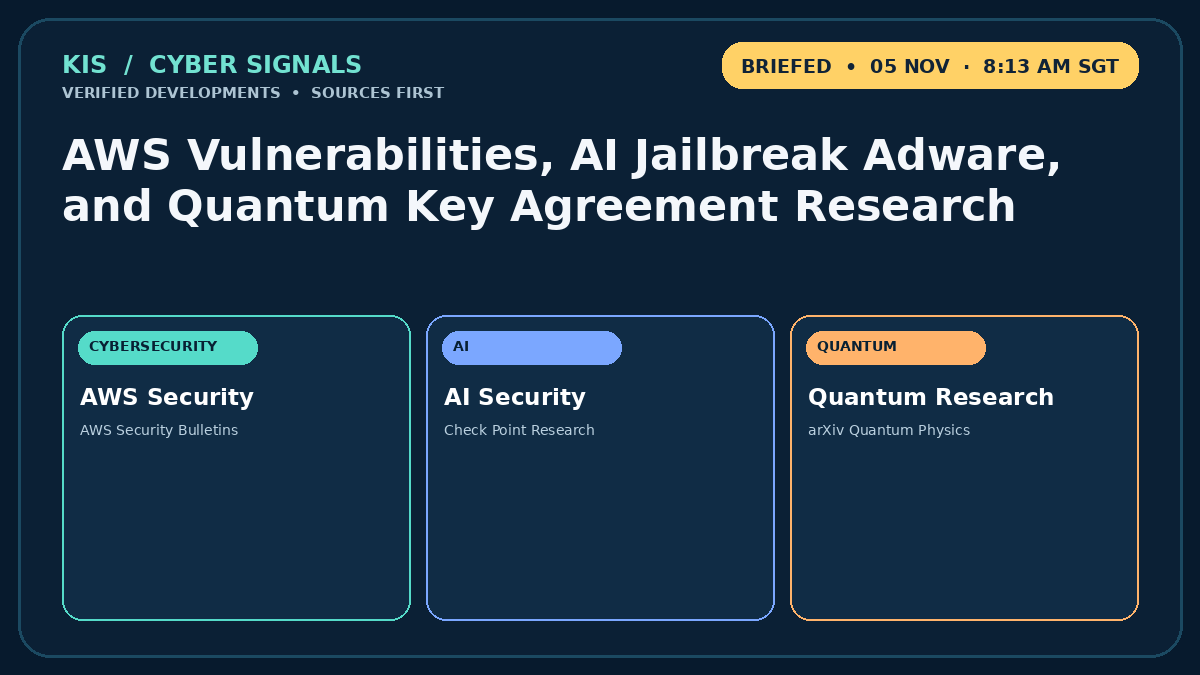
Recent security disclosures highlight critical infrastructure vulnerabilities across AWS components, emerging monetization strategies for AI prompt adware, and theoretical advancements in quantum-resistant cryptographic key agreements.
Cybersecurity: AWS Security
What changed: AWS published multiple security advisories, including CVE-2026-122266 affecting the Amazon EKS Network Policy Agent and CVE-2026-122192 affecting Firecracker VM memory handling.
Why it matters: Improper isolation in shared eBPF connection tracking states could allow adjacent users to bypass network policy enforcement, while certain host memory conditions could permit guest access to process memory.
Next step: Administrators should review AWS security bulletins and apply recommended patches for impacted Amazon EKS add-ons and Firecracker versions.
AI: AI Security
What changed: Check Point Research analyzed the Haiou jailbreak bundle targeting OpenAI Codex, identifying it as prompt adware that injects commercial gateway advertisements into agent responses.
Why it matters: While distributed as a tool to weaken model guardrails, the bundle modifies configuration files to promote an opaque LLM gateway, illustrating new distribution models for AI-targeted adware.
Next step: Organizations should monitor and restrict the integration of unvetted third-party jailbreak bundles and configuration scripts in AI development environments.
Quantum: Quantum Research
What changed: Researchers introduced the Quantum Computational Timelock model, combining time-lock encryption with a quantitative noisy-quantum-storage assumption to establish everlasting secure key agreements.
Why it matters: This research provides mathematical frameworks for asymptotic key-rate bounds and composable trace distance under individual quantum attacks, supporting future post-quantum cryptographic standards.
Next step: Security researchers and standards bodies should track the theoretical progress of hybrid quantum-computational security models for long-term data protection.
Organizations must continuously update infrastructure components while monitoring emerging threats across both traditional enterprise software and modern AI deployment pipelines.
Primary sources
- CVE-2026-122266 – Improper isolation of shared resources in aws-network-policy-agent in Amazon EKS — AWS Security Bulletins
- Free the Model, Sell the Gateway: Prompt Adware hidden in Jailbreak Bundles — Check Point Research
- Everlasting secure key agreement from a quantum computational hybrid security model — arXiv Quantum Physics