
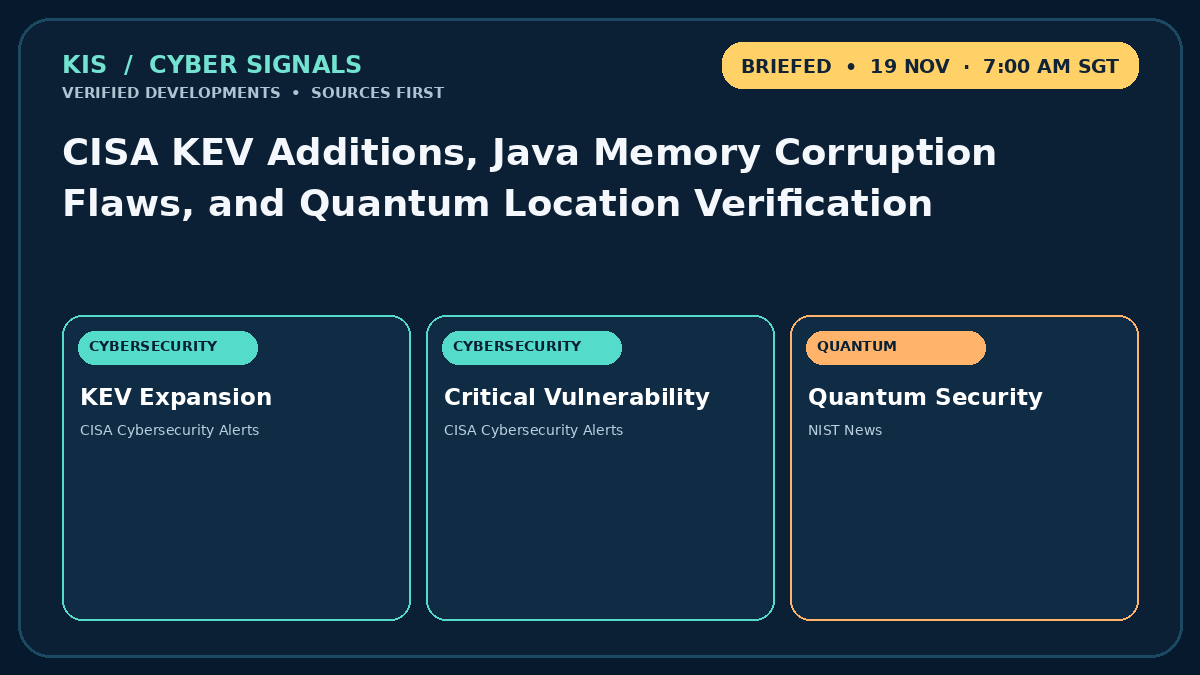
Recent cyber security advisories highlight active exploitation of enterprise software along with critical vulnerability disclosures in ubiquitous infrastructure components. Concurrently, government researchers have validated physical location verification protocols built upon quantum physics principles.
Cybersecurity: KEV Expansion
What changed: CISA added four new vulnerabilities to its Known Exploited Vulnerabilities catalog based on evidence of active exploitation, covering flaws in Synology DiskStation Manager, BerriAI LiteLLM, Apache Axis, and Vanderbilt University REDCap.
Why it matters: Known exploited vulnerabilities pose an immediate risk to public- and private-sector networks, making rapid identification and prioritization essential to prevent unauthorized access.
Next step: Federal agencies and enterprise security teams must review asset inventories for publicly exposed installations of the affected products and prioritize immediate remediation in accordance with policy guidelines.
Cybersecurity: Critical Vulnerability
What changed: CISA and international partners urged immediate patching for CVE-2026-114938, a critical memory-corruption flaw in the x86-64 HotSpot Java Virtual Machine Base64 decoder that allows unauthenticated remote code execution.
Why it matters: Because Java Virtual Machines are widely embedded across enterprise software, container images, and third-party applications, unauthenticated remote code execution flaws create widespread exposure across internet-facing systems.
Next step: Organizations should audit software inventories to identify bundled JDK runtimes, apply vendor patches immediately, and restrict Base64 input at application boundaries where immediate patching is not feasible.
Quantum: Quantum Security
What changed: NIST researchers demonstrated a technique leveraging quantum physics to verify a person's physical location.
Why it matters: Proving identity and physical position using quantum mechanics offers novel defensive capabilities against spoofing, phishing, and location-tampering attacks on critical infrastructure and financial systems.
Next step: Security architects and identity management teams should monitor emerging quantum-based location verification protocols as practical implementation standards mature.
Organizations should audit external assets against newly cataloged exploit vectors and ensure embedded Java dependencies are patched against remote code execution risks.
Primary sources
- CISA Adds Four Known Exploited Vulnerabilities to Catalog — CISA Cybersecurity Alerts
- Critical Java Vulnerability Requires Immediate Patching — CISA Cybersecurity Alerts
- Quantum Physics Can Verify a Person’s Location, NIST Researchers Show — NIST News