
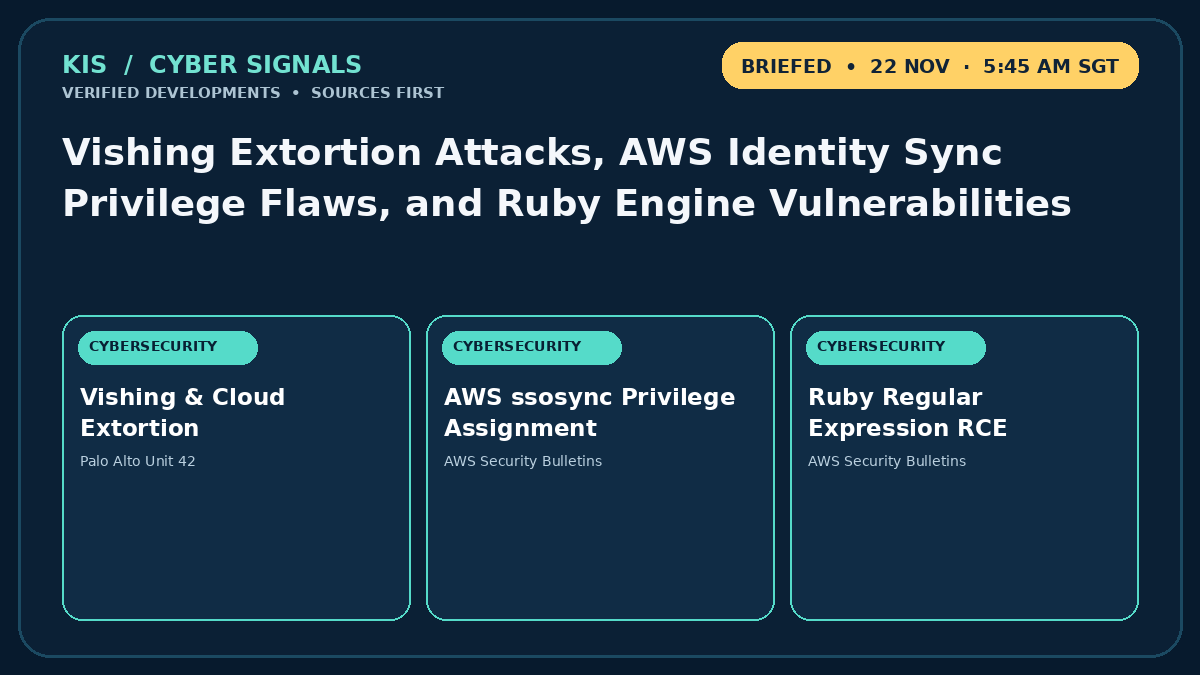
This briefing highlights active social engineering techniques alongside critical vendor security updates. Palo Alto Networks Unit 42 released research on high-profile vishing and cloud extortion tactics targeting healthcare and financial sectors, while AWS issued security bulletins addressing identity privilege assignment flaws in ssosync and memory corruption vulnerabilities in CRuby.
Cybersecurity: Vishing & Cloud Extortion
What changed: Palo Alto Networks Unit 42 published an analysis detailing voice phishing (vishing) campaigns conducted by 'Com' affiliates, which leverage targeted social engineering to compromise cloud environments and extort healthcare and finance organizations.
Why it matters: Attackers are increasingly bypassing perimeter defenses through voice-based credential harvesting, allowing them to breach cloud data repositories and initiate double-extortion demands without relying on complex exploit chains.
Next step: Organizations should reinforce multi-factor authentication controls, implement strict identity verification procedures for help desks, and limit cloud data access policies.
Cybersecurity: AWS ssosync Privilege Assignment
What changed: AWS disclosed CVE-2026-133199 in AWS ssosync versions prior to 2.9.5, where user and group reconciliation logic incorrectly assigns privileges when Google Workspace email addresses or group names are reused.
Why it matters: An authenticated remote user with a reused Google Workspace identity could automatically inherit the IAM Identity Center group memberships and permission sets of a previously synchronized, unrelated user.
Next step: Administrators utilizing AWS ssosync should immediately update to version 2.9.5 or later to correct identity reconciliation logic.
Cybersecurity: Ruby Regular Expression RCE
What changed: AWS highlighted upstream fixes for CRuby addressing CVE-2026-132825 and related memory-safety vulnerabilities in the regular expression engine and string case conversion routines for versions prior to 4.0.10, 3.4.13, and 3.3.14.
Why it matters: Unauthenticated remote attackers processing third-party input through web applications (including Rack, Rails, and Sinatra frameworks) can cause memory corruption, leading to application crashes, memory leakage, or arbitrary code execution.
Next step: Development teams should audit environment dependencies and update Ruby runtimes to non-vulnerable patch versions immediately.
Security teams are advised to prioritize identity governance updates and runtime engine patching while enhancing employee awareness against sophisticated voice phishing tactics.
Primary sources
- Dialing for Data: Inside the Com’s High-Profile Heists — Palo Alto Unit 42
- CVE-2026-133199 – Incorrect privilege assignment on reused e-mail addresses or group names in AWS ssosync — AWS Security Bulletins
- CVE-2026-132825 and related issues – Ruby regular expression engine and string case conversion — AWS Security Bulletins